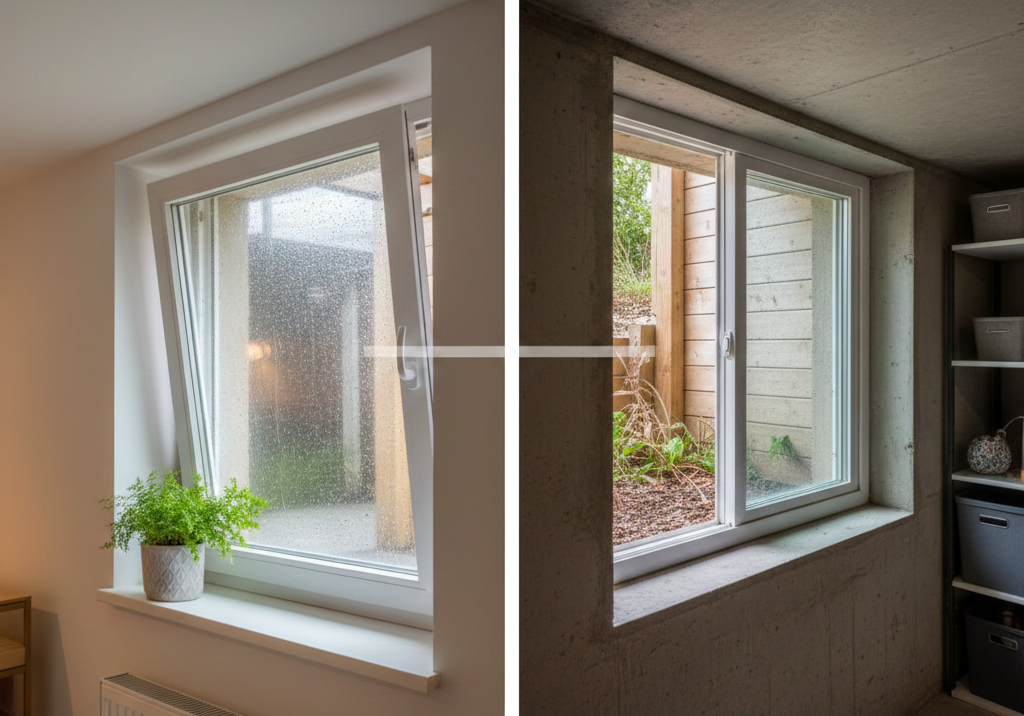
Nearly 40% of Canadian basements have moisture problems. This is because of bad window seals and poor air flow. The right basement window is key for comfort, energy savings, and looks.
Hopper windows open from the top and fit well in small spaces. They’re great for basements. Slider windows slide open and are best for longer walls where you want to see more and open easily.
In Canada, the weather changes a lot. So, windows need to keep energy in and air out well. When choosing, think about air flow, getting out, keeping warm, cost, and small basement spaces.
Key Takeaways
- Hopper windows tilt inward and suit small, below-grade openings where sealing and ventilation matter most.
- Slider windows operate horizontally and are ideal for longer, low-wall openings with a need for wider glass area.
- Energy efficiency and sealing are essential in Canada to prevent moisture and reduce heating costs.
- Total Home Windows & Doors is a local GTA manufacturer to consider for vinyl basement window options.
- We’ll compare performance, cost, and best uses to help with choosing the right basement window type.
Window and Doors Replacement Near Me
What is a Hopper Window?
A hopper window is a type of window that opens from the bottom. It tilts inward from the top. This design is great for basements and cellars where space is tight.
Opening a hopper window is easy. Just use a latch or crank to tilt it in. This makes cleaning the window from inside easy. It’s a big plus for basement windows.
Hopper windows don’t take up much space outside. They tilt inward, so they don’t block walkways or gardens. They let in air without needing a big opening. They can also meet safety standards if they’re the right size and installed correctly.
These windows can be very energy-efficient. Look for ones with double or triple glazing and special coatings. Brands like Pella and Andersen make ENERGY STAR®-rated hopper windows. These are great for keeping warm in Canada.
Security and ease of use are key. Look for models with strong locks and safety latches. Their slim design and inward tilt make them look modern and neat.
But, there are downsides. Hopper windows are smaller than sliders, so they let in less light. Some models have latches that are harder to use than cranks. Also, the inward tilt can make it hard to move furniture in basements.
Seal quality is important. Some hopper windows use weatherstripping, which might not be as tight as other seals. This can affect how well they keep air out. It’s something to think about if you want a window that saves energy.
Hopper windows are best for places like basements, bathrooms, and attics. They’re good where you need to save space or keep things private. Make sure to get them installed by a pro to ensure they work well and meet safety standards.
To keep your hopper windows in good shape, check the seals and lubricate the hinges. Replace any old caulking to keep air and moisture out. There are also newer types of hopper windows that are even better for certain needs.
What is a Slider Window?
Slider windows move horizontally on a track. They are great for places where vertical space is tight. They let in lots of light and offer wide views.
They save space and slide smoothly. Brands like Total Home Windows & Doors make them. They use durable vinyl, have strong locks, and keep energy in.
Slider windows are perfect for basements and rec rooms. They let in lots of natural light. They are easy to use and don’t swing out, saving space.
But, sliders open only half their width. This might limit air flow. You also need to keep the track clean to avoid blockages.
Sliders work best for long walls that need lots of light. They’re good where hoppers would get in the way. They look modern and work well if sized right.
Choose sliders with double or triple glazing for better energy use. Look for brands from Canada for quality. Make sure they meet egress rules for emergency exits.
Explore energy-efficient options
Compare Energy Efficiency Between Hopper and Slider Windows: Comparison Table
We look at energy factors to help homeowners choose between hopper and slider windows for basements in Canada. We focus on sealing, glazing, operation, and maintenance. This gives you practical, fact-based advice.
Sealing is key for keeping air out. Hopper windows often use weatherstripping or compression seals. Sliders use compression seals in better models. Compression seals are usually better at keeping air out.
Glazing choices affect how well windows keep heat in. Both types support double- or triple-pane glass, low-E coatings, and special gas fills. When these match, both types perform almost the same.
How you use the window affects its performance over time. Hoppers close well if the latch is good. Sliders need good tracks and rollers. Bad tracks or worn rollers let air in.
Keeping your windows in good shape is important. Bad seals, weather-stripping, or dirty tracks lower insulation. Regular checks and quick fixes keep them working well.
| Energy Factor | Hopper Window (typical) | Slider Window (typical) |
|---|---|---|
| Sealing type | Often weatherstripping; higher-end models use compression seals; latch quality critical for airtightness | Compression seals common on quality units; track compression and roller condition govern leakage |
| Glazing options | Double- or triple-pane IGUs, low-E available, argon/krypton fills supported | Double- or triple-pane IGUs, low-E available, argon/krypton fills supported |
| Typical U-value range | Comparable when using similar IGUs; depends on glass spec and spacer systems | Comparable when using similar IGUs; depends on glass spec and spacer systems |
| Typical U-value range | Comparable when using similar IGUs; depends on glass spec and spacer systems | Comparable when using similar IGUs; depends on glass spec and spacer systems |
| Operation impact | Tight closure if latch and seal are high quality; inward tilt aids pressure seal | Dependent on track condition; high-quality hardware and multi-point locking improve seal |
| Maintenance effect | Worn weather-stripping lowers performance; regular checks restore efficiency | Dirty tracks and worn rollers increase infiltration; cleaning and part replacement preserve efficiency |
| Manufacturer practices | Modern Canadian manufacturers can achieve strong energy efficiency with compression seals and certified IGUs | Manufacturers like Total Home Windows and Doors emphasize tight seals and multi-point locking to boost slider performance |
| Real-world note | Entry-level hoppers with basic weatherstripping may lag behind sliders with compression seals | Entry-level sliders with quality compression seals often show better airtightness than weatherstrip hoppers |
Choose certified low-E glass, inert gas fills, and compression-seal designs when comparing. Proper installation at the frame-to-wall junction is key for cold Canadian winters.
When comparing hopper and slider windows, focus on glazing and seals. If both have the same glazing and hardware, their energy efficiency will be similar. Differences come from seal type and installation quality.
Cost Analysis: Comparison Table
We’ve broken down the costs of hopper and slider basement windows. This helps you see the real costs. Things like unit price, glazing, hardware, and installation all play a part.
Smaller hopper units are often cheaper for basic needs. But, sliders can cost more for larger glass areas or better frames. Upgrades like double glazing add similar costs to both.
Choosing the right hardware can change the price. Hoppers with cranks and locks cost more. Sliders with better rollers and frames also increase the price. High-end options for both are the priciest.
How easy it is to install affects the cost. Hoppers might need extra framing and waterproofing. Sliders need bigger openings and careful preparation. Both can add to the total cost.
Local prices matter too. In the Greater Toronto Area, what you pay can vary. Companies like Total Home Windows & Doors offer packages that affect prices and delivery times.
Think about long-term costs like energy savings and maintenance. Energy-efficient glass can save on heating. But, replacing tracks and maintaining seals can add to the cost over time.
Get quotes from different suppliers and compare them carefully. Make sure the specs are the same. Upgrades for egress can increase the cost of either type.
For a tight budget, small hoppers might be the best choice. But, if you want more light and a modern look, sliders might be worth the extra cost.
| Cost Factor | Hopper | Slider |
|---|---|---|
| Typical unit price | Lower for basic small units; affordable entry-level options | Higher for larger glass areas; premium frame options raise price |
| Glazing upgrades | Double/triple glazing, low-E, argon add similar cost | Same incremental cost for equivalent glazing packages |
| Hardware & operation | Cranks and multi-point locks increase cost; tilt hybrids cost more | Quality rollers, tracks and premium locks raise price |
| Installation complexity | May need reinforced framing and extra waterproofing at foundation | Requires larger rough openings and precise sill prep |
| Egress compliance | May need larger size or well excavation to meet code | Often easier to meet daylight/egress with larger slider options |
| Labour & local market | GTA rates and local installers like Total Home Windows & Doors affect quotes | Same local factors; packaged install options can change value |
| Maintenance & lifecycle cost | Lower upfront but seals and hardware replacement add future cost | Higher upfront but larger glass can raise heating/cooling impacts without upgrades |
| Practical guidance | Best for tight budgets and small openings | Best for finished basements needing daylight and modern aesthetics |
When deciding between hopper and slider windows, think about the long-term. Balance the initial cost with energy savings and lifespan. The right choice depends on your needs and budget. Get quotes from local suppliers to make an informed decision.
Hopper vs Slider: What’s Best for Your Home?
Choosing the right basement window is key for our Canadian homes. We look at space, light, and code needs. Hopper windows are great for tight spots, like narrow walkways. Slider windows bring more light and a modern feel to finished basements.
Let’s compare hopper and slider windows. Sliders offer more light and are easy to use. But, they need track care. Hoppers let in air, are easy to clean inside, and meet egress rules if sized right. Energy savings depend on the model’s seals, glazing, and coatings, not the style.
For a smart choice, measure the space and check egress rules. Look at exterior clearance too. Ask for specific glazing, sealing, and energy ratings. Get quotes from trusted local suppliers to compare options.
In short, choose a hopper for control and easy cleaning in tight spots. Pick a slider for more light and a modern look. Our choice should be based on specs, performance data, and expert installation for lasting comfort.
FAQ
What is the main difference between hopper and slider basement windows?
Hopper windows open from the bottom and tilt inward. They are great for small spaces and easy cleaning. Slider windows move horizontally and offer more glass for better views.
Which window type provides better ventilation for a basement?
Hopper windows control airflow better because they tilt inward. Sliders can also ventilate well, but only half opens. The size and setup of the windows affect how well they ventilate.
Are hopper windows suitable for egress in basements?
Many hopper windows meet egress needs if they meet size and installation rules. Always check local rules and the window’s size before using a hopper for egress.
Do slider windows offer better daylight and views than hoppers?
Yes. Slider windows have more glass and better views. They are best for basements where you want more light and views.
Which window type is more energy efficient in Canadian climates?
Hoppers and sliders can be energy efficient if they have good glazing and seals. Sealing well is key. Quality and installation matter for winter in Canada.
Are slider windows harder to maintain than hoppers?
Sliders need track cleaning and lubrication. Hoppers need hinge and latch care and seal checks. Hoppers are easier to clean from inside.
Which option is more cost‑effective upfront and long term?
Hoppers are cheaper upfront. Sliders cost more but save on energy bills with better glazing. Installation costs and local rates affect the total cost.
Can both window types be ENERGY STAR® rated?
Yes. Both can be ENERGY STAR® rated with the right features. Look for certified data when comparing.
How should we choose between hopper and slider for our basement?
Measure the space and check egress rules first. Choose a hopper for small spaces and control. Choose a slider for more light and views. Focus on quality and installation.
Where can we source quality vinyl basement windows in the Greater Toronto Area?
Total Home Windows & Doors in the GTA offers quality vinyl windows. They meet local needs. Local suppliers ensure the right fit and installation.