

You’re standing in the showroom, comparing what looks like two identical windows, but one costs nearly double the other. The difference isn’t always visible at first glance, but it matters enormously. Commercial windows are engineered for high-traffic buildings with stringent safety codes, while residential windows prioritise home comfort and curb appeal. Commercial units typically feature heavier gauge frames, thicker glass assemblies, and reinforced hardware designed to withstand constant use and meet building code requirements for multi-unit structures. Residential windows focus on energy efficiency, aesthetic versatility, and ease of operation for single-family homes. This article breaks down the mechanical differences, cost implications, durability benchmarks, and helps you determine which specification suits your project—whether you’re upgrading a home or outfitting a commercial property.
At-a-Glance Comparison Table
| Feature | Commercial Windows | Residential Windows |
|---|---|---|
| Frame Gauge | Heavier (0.060″–0.125″) | Standard (0.045″–0.060″) |
| Best Use Case | Multi-storey buildings, high-rise | Single-family homes, townhouses |
| Glass Thickness | 6mm–12mm, often laminated | 3mm–6mm, dual-pane |
| Energy Efficiency | Moderate (code-compliant) | High (ENERGY STAR™ certified) |
| Price Range (per window) | $800–$2,500+ | $350–$900 |
| Maintenance | Scheduled professional service | Homeowner-friendly cleaning |
| Available Sizes | Custom, oversized | Standard, limited custom |
| Common Materials | Aluminum, steel-reinforced vinyl | Vinyl, fibreglass, wood |
Window and Doors Replacement Near Me
Commercial Windows Overview
Commercial windows are built to meet the demands of multi-unit residential buildings, office towers, retail spaces, and institutional facilities. They open via heavy-duty hinges or pivot mechanisms, often requiring commercial-grade operators. Installation occurs in curtain wall systems or punched openings with structural anchoring that distributes wind load across the building envelope.
Key advantages:
- Superior structural integrity with reinforced frames that resist deflection under high wind pressure
- Compliance with stringent fire ratings, impact resistance, and accessibility codes required by the National Building Code of Canada
- Longer warranty periods (often 10–20 years) backed by commercial-grade testing protocols
- Customisation for oversized openings, specialty shapes, and integration with building automation systems
- Enhanced security features including multi-point locking and laminated glass options
Limitations and trade-offs:
- Significantly higher upfront cost due to material specifications and engineering requirements
- Installation requires specialised contractors familiar with commercial glazing techniques and safety protocols
- Aesthetic options are more limited, favouring function over decorative detailing
- Heavier weight demands reinforced wall framing and may complicate retrofits in older structures
Ideal use cases: Best for condominium developments, office buildings, hospitals, schools, and any structure requiring compliance with commercial building codes. Essential for projects above three storeys where wind load calculations and fire safety ratings become critical.
Find related services
Residential Windows Overview
Residential windows are designed for single-family homes and low-rise townhouses, prioritising comfort, visual appeal, and operational simplicity. They operate via sash balances, cranks, or sliding tracks, with hardware scaled for occasional daily use rather than institutional wear. Most units ship as complete assemblies ready for rough opening installation.
Key advantages:
- Cost-effective pricing that fits typical home renovation budgets without sacrificing quality
- Wide range of styles including casement, double-hung, slider, and specialty shapes to match architectural themes
- ENERGY STAR™ certified options that deliver measurable reductions in heating and cooling costs
- Easier DIY-friendly maintenance with accessible hardware and standard replacement parts
- Lighter frames that simplify installation and reduce structural demands on existing walls
Limitations and trade-offs:
- Lower frame gauge makes them less suitable for high-wind coastal or high-rise applications
- Shorter lifespan in high-traffic or commercial environments due to lighter-duty hardware
- Size restrictions—most manufacturers cap standard sizes at 72″ height to maintain structural integrity
Ideal use cases: Perfect for detached homes, duplexes, bungalows, and low-rise residential buildings. Excellent choice when you need vinyl windows that balance performance, aesthetics, and affordability without commercial code requirements.
Explore energy-efficient options
Head-to-Head: Key Decision Factors
Durability and Structural Performance
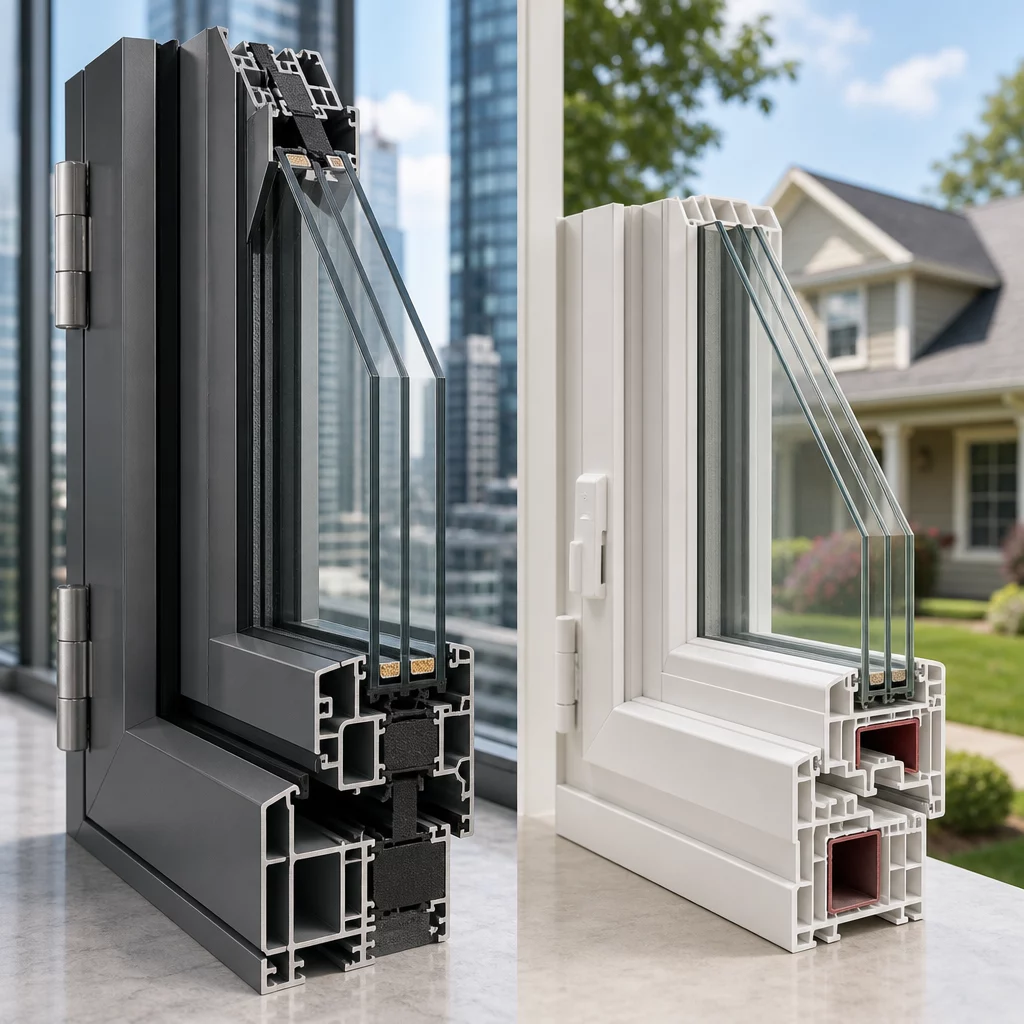
Commercial windows use thicker aluminium extrusions (often 0.125″ wall thickness) and steel-reinforced frames that resist deflection under sustained wind pressure exceeding 200 km/h. Residential units typically employ 0.045″–0.060″ vinyl or fibreglass profiles adequate for wind loads up to 150 km/h, which covers most Canadian residential zones. According to the National Building Code of Canada, commercial installations must meet higher performance grades (CW-PG50 or above) compared to residential (R-PG25 to R-PG35).
“Commercial projects demand windows that can handle thousands of opening cycles per year without hardware failure. We see frame deflection and seal degradation in residential units when they’re misapplied in commercial settings, which is why material specification matters from day one,” says Vitaly Shapiro, Vice President of Sales.
Energy Efficiency
Residential windows often outperform commercial units in thermal efficiency because they prioritise insulation over structural mass. Vinyl frames with multi-chamber construction and Low-E glass achieve U-values as low as 0.20, while commercial aluminium frames with thermal breaks typically range from 0.30 to 0.45. However, commercial windows compensate with larger glass areas that maximise natural light, reducing daytime lighting loads.
| Window Type | Typical U-Value | SHGC Range | Air Infiltration (L/s/m²) |
|---|---|---|---|
| Commercial Aluminium | 0.30–0.45 | 0.25–0.40 | ≤1.5 |
| Residential Vinyl | 0.20–0.28 | 0.20–0.35 | ≤1.0 |
| Residential Fibreglass | 0.18–0.25 | 0.22–0.32 | ≤0.8 |
Most residential installations from Total Home Windows and Doors include ENERGY STAR™ certified glazing packages that qualify for provincial rebates, delivering faster payback through reduced utility bills.
Security
Commercial windows incorporate multi-point locking systems with up to five latch points, often keyed for master access in institutional settings. Laminated glass options provide forced-entry resistance and prevent complete panel shattering. Residential windows use two- to three-point locks adequate for home security, with optional TotalSeal Multi-Point Locking upgrades available for enhanced protection.
“In residential retrofits, homeowners often ask about commercial-grade locks. While they add security, the real vulnerability is usually the door, not the window. We recommend balancing lock quality with proper installation and complementary measures like motion lighting,” notes Daniel Klein, Project Manager.
Ease of Operation and Accessibility
Residential windows feature user-friendly cranks, tilt latches, and lift rails designed for homeowners of all ages. Commercial units may require greater force to operate due to heavier sashes and institutional-grade hardware. For accessibility compliance, commercial projects must meet barrier-free design standards with maximum opening forces of 22N, whereas residential applications have more flexibility.
Price and Installation Cost
Commercial windows cost 2–3 times more than residential equivalents due to engineering, testing, and material specifications. Installation labour also runs higher because commercial glaziers charge $85–$150 per hour versus $60–$90 for residential installers.
| Window Type | Material Cost (per unit) | Installation Cost | Total Installed |
|---|---|---|---|
| Commercial Fixed (4’×6′) | $900–$1,800 | $400–$700 | $1,300–$2,500 |
| Commercial Casement (3’×5′) | $1,200–$2,200 | $500–$800 | $1,700–$3,000 |
| Residential Vinyl Casement (3’×5′) | $350–$650 | $200–$350 | $550–$1,000 |
| Residential Fibreglass (3’×5′) | $500–$900 | $250–$400 | $750–$1,300 |
Regional variations apply—GTA pricing trends 10–15% higher than rural Ontario due to labour rates and permit costs.
Maintenance and Lifespan
Commercial windows require professional maintenance every 2–3 years, including hardware lubrication, seal inspection, and operator adjustment. Residential units need basic homeowner cleaning and occasional weatherstripping replacement. Commercial aluminium frames can last 30–40 years with proper care, while residential vinyl typically delivers 20–25 years before seal failure or hardware wear necessitates replacement.
Aesthetics and Curb Appeal
Residential windows offer extensive colour palettes, grid patterns, and hardware finishes to match home styles from Victorian to contemporary. Commercial windows prioritise clean sightlines and uniformity, typically available in anodised aluminium, bronze, or black finishes. For homeowners seeking architectural impact, bay windows and picture windows provide design flexibility that commercial storefront systems cannot match.
Find the Best Window Styles for your Home
Which Should You Choose?
Choose commercial windows if:
- Your project is a multi-storey building (four floors or higher) requiring engineered wind load calculations
- Building codes mandate CW-grade performance ratings and fire-resistance classifications
- You need oversized units exceeding 8 feet in height or width for curtain wall applications
- The installation involves high-traffic institutional use with thousands of annual operation cycles
- Budget allows for premium upfront investment in exchange for extended lifespan and lower lifecycle costs
Choose residential windows if:
- You’re renovating a single-family home, duplex, or low-rise townhouse under three storeys
- ENERGY STAR™ certification and utility cost reduction are top priorities
- You want design flexibility with multiple styles, colours, and decorative options
- Installation timeline and budget favour faster, more cost-effective solutions
- Maintenance will be handled by homeowners rather than building management staff
The decision hinges on building type and regulatory requirements. Residential specifications excel in homes where comfort and efficiency matter most. Commercial grades become non-negotiable when codes, safety, and structural demands dictate performance thresholds beyond residential capabilities.
Best window companies reviews
Making the Right Choice for Your Project
If you’re outfitting a home, residential windows from Total Home Windows and Doors deliver the right balance of performance, aesthetics, and value. For multi-unit or commercial builds, engineered commercial systems ensure code compliance and long-term durability. Understanding frame gauge, glazing specifications, and installation requirements prevents costly mismatches between window type and application.
Whether you need aluminium windows for a commercial retrofit or energy-efficient vinyl for your home, selecting the correct specification ensures decades of reliable service. Total Home Windows and Doors offers BBB A+ accreditation and a 4.9 Google rating, backed by expert guidance from project planning through final installation.
Ready to upgrade your windows with the right specification? Get a free quote today and discover how the correct window choice transforms your building’s performance, comfort, and value.
Frequently Asked Questions
Can I use residential windows in a small commercial building?
Only if the building meets residential code classifications. Most municipalities require commercial-grade windows for any structure with more than three dwelling units or mixed-use occupancy, regardless of size.
Do commercial windows qualify for ENERGY STAR™ certification?
Yes, but fewer models meet the stringent thermal performance thresholds compared to residential lines. Aluminium frames with thermal breaks can achieve certification when paired with high-performance glazing packages.
How much weight difference exists between commercial and residential windows?
Commercial units typically weigh 40–60% more due to heavier gauge frames and thicker glass. A standard 3’×5′ commercial casement weighs 35–45 kg versus 20–28 kg for residential vinyl equivalents.
Will commercial windows reduce noise better than residential models?
Generally yes, due to thicker glass and heavier frame mass. Laminated glass options in commercial specifications provide superior sound dampening, achieving STC ratings of 35–42 compared to 28–32 for standard residential units.
Can I mix commercial and residential windows in the same building?
Building codes typically prohibit mixing unless separated by fire-rated assemblies. Aesthetic inconsistencies and warranty complications also make mixed installations impractical for most projects. Consult local building officials before specifying.