

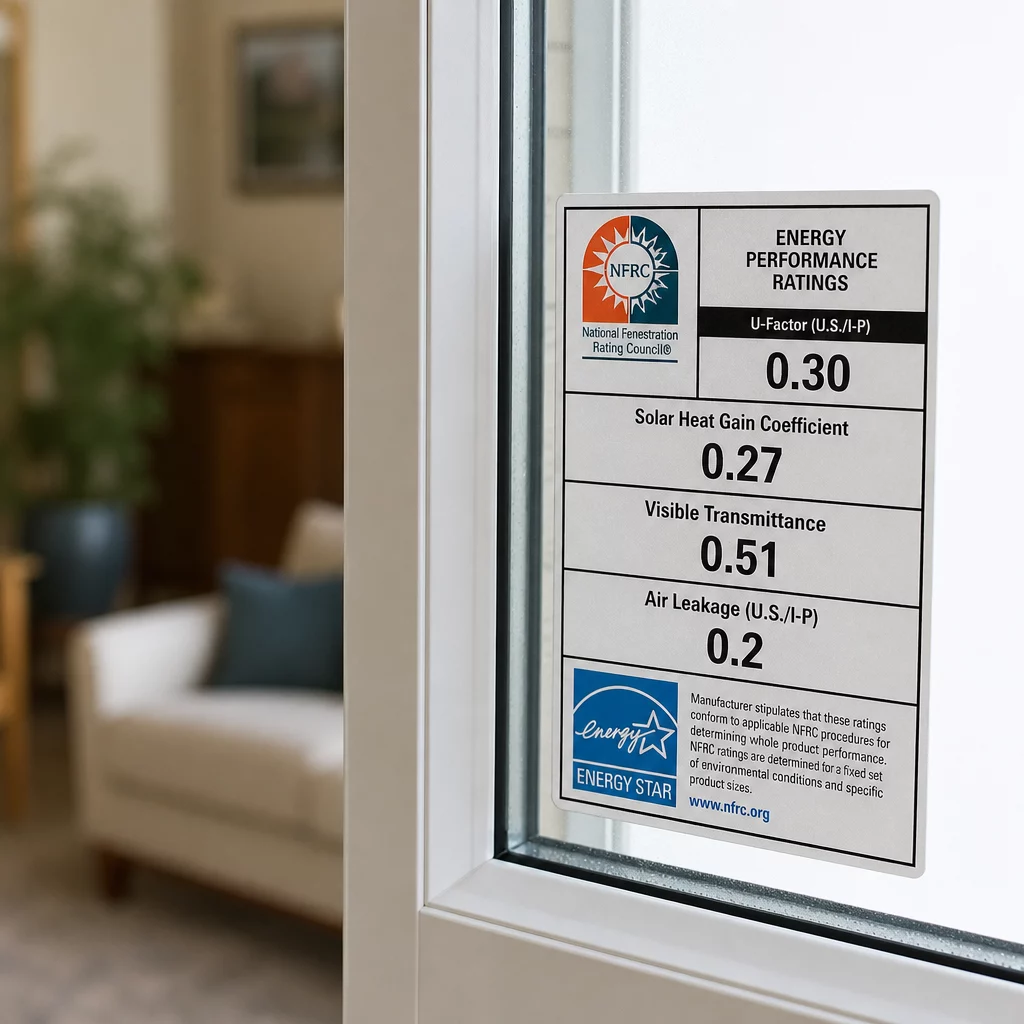
NFRC ratings are standardised measurements that evaluate how well windows and doors perform in terms of energy efficiency, with scores calculated through rigorous laboratory testing of four key metrics: U-Factor (heat transfer), Solar Heat Gain Coefficient (SHGC), Visible Transmittance (VT), and Air Leakage (AL). These ratings, displayed on the NFRC label, help Canadian homeowners compare products objectively and select energy-efficient windows that reduce heating costs and improve comfort year-round.
Key Takeaways
- NFRC ratings provide independent, third-party verification of window and door energy performance through standardised testing protocols
- U-Factor measures heat loss—lower numbers indicate better insulation, critical for Canadian winters
- Solar Heat Gain Coefficient determines how much solar radiation passes through, affecting cooling and heating loads
- All Total Home windows meet ENERGY STAR™ certification requirements with verified NFRC ratings for optimal performance
- Understanding these scores empowers homeowners to make informed decisions that reduce energy bills by 15-30% annually
Window and Doors Replacement Near Me
What Does NFRC Stand For and Why Does It Matter?
The National Fenestration Rating Council (NFRC) is a non-profit organisation that establishes uniform standards for rating window, door, and skylight energy performance. Founded in 1989, NFRC created a consistent testing methodology that eliminates manufacturer bias and provides reliable data for consumers. Before NFRC standards existed, manufacturers used different testing methods, making product comparisons nearly impossible.
For Canadian homeowners, NFRC ratings matter because they directly impact heating costs, comfort levels, and eligibility for energy rebates. The Natural Resources Canada references NFRC standards when determining ENERGY STAR™ certification for windows sold in Canada. Products without NFRC certification cannot qualify for government energy efficiency programmes or rebates.
Find related services
How Are the Four Core NFRC Ratings Calculated?
NFRC ratings come from controlled laboratory testing that simulates real-world conditions. Independent accredited laboratories test complete window assemblies—not just glass—including frames, spacers, and weatherstripping. This holistic approach ensures ratings reflect actual installed performance rather than theoretical values.
Testing follows strict protocols outlined in NFRC technical documents. Manufacturers cannot cherry-pick favourable test results; they must test representative samples from each product line. Third-party inspection agencies verify that production units match tested specifications, maintaining rating accuracy over time.
U-Factor: Measuring Heat Transfer Through Your Windows
U-Factor quantifies how much heat passes through a window assembly, measured in watts per square metre per degree Celsius (W/m²·K) or British thermal units (BTU/hr·ft²·°F). Lower U-Factor numbers indicate better insulating properties. In Canadian climates, windows with U-Factor values below 1.4 W/m²·K (0.25 BTU/hr·ft²·°F) significantly reduce heating costs.
Testing involves placing window samples between two controlled climate chambers—one simulating interior conditions, the other mimicking winter outdoor temperatures. Sensors measure heat flow through the entire assembly over extended periods. Frame material, glass coatings, gas fills, and spacer systems all influence the final U-Factor score.
“Many homeowners focus exclusively on glass performance, but frame construction accounts for 25-30% of total window U-Factor. Our vinyl windows feature multi-chamber frames that dramatically improve thermal resistance compared to older single-chamber designs.” — Vitaly Shapiro, Vice President of Sales
Solar Heat Gain Coefficient: Controlling Sun Energy
Solar Heat Gain Coefficient (SHGC) measures the fraction of solar radiation that enters through a window as heat. Values range from 0 to 1, with lower numbers blocking more solar heat. In Canada, optimal SHGC varies by region and window orientation. South-facing windows benefit from higher SHGC (0.40-0.60) to capture winter warmth, whilst west-facing units perform better with lower values (0.25-0.35) to reduce summer cooling loads.
NFRC laboratories use spectrophotometers to analyse how glass assemblies transmit, reflect, and absorb solar radiation across the electromagnetic spectrum. Testing accounts for both direct beam radiation and diffuse sky radiation. The resulting SHGC number helps homeowners balance passive solar heating benefits against unwanted heat gain.
| Climate Zone | Recommended U-Factor | Recommended SHGC | Annual Savings Potential |
|---|---|---|---|
| Southern Ontario | ≤ 1.4 W/m²·K | 0.30-0.40 | $250-$400 |
| Northern Ontario | ≤ 1.2 W/m²·K | 0.35-0.50 | $350-$550 |
| Coastal BC | ≤ 1.6 W/m²·K | 0.25-0.35 | $200-$350 |
| Prairie Provinces | ≤ 1.0 W/m²·K | 0.40-0.55 | $400-$650 |
Visible Transmittance: Balancing Light and Efficiency
Visible Transmittance (VT) indicates how much visible light passes through a window, expressed as a value between 0 and 1. Higher VT numbers mean more natural daylight enters your home. Standard clear double-pane windows typically achieve VT values around 0.60-0.70, whilst high-performance Low-E windows range from 0.40-0.60 depending on coating type.
Testing measures light transmission across the visible spectrum (380-780 nanometres) using integrating sphere photometers. The challenge lies in maximising VT whilst maintaining low U-Factor and appropriate SHGC. Advanced selective coatings allow high visible light transmission whilst blocking infrared and ultraviolet wavelengths, achieving optimal balance for Canadian homes.
Air Leakage: Preventing Unwanted Drafts
Air Leakage (AL) quantifies how much air passes through a closed window assembly under pressure differences. Measured in cubic feet per minute per square foot of window area (cfm/ft²) or litres per second per square metre (L/s·m²), lower values indicate tighter seals. Quality windows achieve AL ratings below 0.15 cfm/ft² (0.75 L/s·m²).
NFRC testing applies standardised pressure differentials across window assemblies whilst measuring airflow with calibrated instruments. The TotalSeal Multi-Point Locking System used in our casement windows creates compression seals that virtually eliminate air infiltration, often achieving AL values below 0.05 cfm/ft².
“Air leakage testing reveals quality differences that aren’t visible to the naked eye. We’ve measured competitor windows with AL ratings three times higher than our units, which translates to significantly higher heating costs and reduced comfort. The weatherstripping system and frame tolerances make all the difference.” — Daniel Klein, Project Manager
Explore energy-efficient options
How Do NFRC Ratings Relate to ENERGY STAR Certification?
ENERGY STAR™ certification builds upon NFRC ratings by establishing minimum performance thresholds for different Canadian climate zones. To earn ENERGY STAR™ certification, windows must meet specific U-Factor and SHGC requirements verified through NFRC testing. The programme divides Canada into three zones, each with distinct performance criteria reflecting regional climate demands.
All products from Total Home Windows and Doors carry ENERGY STAR™ certification, meaning they’ve passed rigorous NFRC testing and meet or exceed government efficiency standards. This certification makes homeowners eligible for various provincial and federal rebate programmes, often recovering 10-15% of installation costs.
Find the Best Window Styles for your Home
What Additional Metrics Appear on NFRC Labels?
Beyond the four core ratings, NFRC labels sometimes include Condensation Resistance (CR) and UV Transmittance values. Condensation Resistance measures a window’s ability to resist moisture formation on interior surfaces, scored from 0 to 100. Higher CR values indicate better performance, with scores above 50 considered excellent for Canadian climates.
UV Transmittance indicates how much ultraviolet radiation passes through glazing. Lower values protect furnishings, flooring, and artwork from fading. Most argon gas windows with Low-E coatings block 95-99% of UV radiation whilst maintaining high visible light transmission.
Best window companies reviews
How Can Homeowners Use NFRC Ratings When Shopping?
Start by identifying your climate zone and prioritising the most relevant metrics. In heating-dominated regions like most of Canada, U-Factor deserves primary attention. Compare products within the same category—double-hung windows against other double-hung units, sliding patio doors against similar doors.
Request NFRC labels for specific products you’re considering. Reputable manufacturers like Total Home Windows and Doors provide complete NFRC documentation for every product line. Be wary of vague efficiency claims without supporting NFRC data. Calculate potential energy savings using online tools that factor in your home’s size, current window performance, and local energy costs.
Do Different Window Styles Achieve Different NFRC Ratings?
Operating style significantly impacts NFRC ratings, particularly Air Leakage values. Fixed windows and picture windows typically achieve the lowest U-Factors and AL ratings because they lack operating hardware and moving parts. Casement and awning windows with compression seals outperform sliding styles in air tightness.
Frame material also influences performance. Vinyl and fibreglass frames generally achieve lower U-Factors than aluminium due to superior insulating properties. However, thermally broken aluminium frames with polyurethane insulation can match or exceed vinyl performance. The key lies in comparing complete assembly ratings rather than making assumptions based on material alone.
| Window Style | Typical U-Factor Range | Typical AL Range | Best Applications |
|---|---|---|---|
| Fixed/Picture | 0.20-0.28 | 0.00-0.05 | Large view areas, passive solar |
| Casement | 0.22-0.30 | 0.05-0.10 | Ventilation, tight seals needed |
| Double-Hung | 0.26-0.32 | 0.10-0.15 | Traditional aesthetics, easy cleaning |
| Sliding | 0.28-0.35 | 0.15-0.25 | Wide openings, limited clearance |
How Often Are NFRC Ratings Updated or Verified?
NFRC requires manufacturers to maintain Product Certification Licenses (PCLs) through ongoing validation. Independent inspection agencies conduct unannounced factory visits and pull production samples for verification testing. If tested units don’t match certified ratings within acceptable tolerances, manufacturers must update labels or face decertification.
When manufacturers modify product designs—changing glass suppliers, spacer systems, or frame extrusions—they must retest and recertify affected product lines. This continuous oversight ensures NFRC labels reflect current production quality rather than outdated test results. Homeowners can verify current certifications through the NFRC’s online Certified Products Directory.
What Role Do Gas Fills and Spacers Play in NFRC Ratings?
Insulating gas fills between panes reduce U-Factor by slowing convective heat transfer. Argon gas, most commonly used, improves U-Factor by approximately 15-20% compared to air-filled units. Krypton gas offers even better performance but costs significantly more. Gas concentration matters—NFRC testing verifies that units contain the declared gas percentage, typically 90% or higher at time of manufacture.
Spacer systems separating glass panes significantly impact edge-of-glass U-Factor. Traditional aluminium spacers create thermal bridges that increase heat loss. Warm-edge spacers made from insulating materials reduce edge conductivity by 50-70%, improving overall window U-Factor by 0.02-0.05 W/m²·K. Our triple-pane windows incorporate advanced warm-edge technology for maximum efficiency.
How Do NFRC Ratings Translate to Real-World Energy Savings?
Energy savings depend on multiple factors: existing window performance, home size, climate zone, heating system efficiency, and energy costs. As a general guideline, upgrading from single-pane windows (U-Factor 5.0) to ENERGY STAR™ certified units (U-Factor 1.4) can reduce heating costs by 25-35% in Ontario climates. Replacing older double-pane windows (U-Factor 2.8) with high-performance models saves 12-18% annually.
Calculate your specific savings potential by multiplying the U-Factor improvement by your total window area and heating degree days. For example, improving 30 square metres of windows by 1.0 W/m²·K in Toronto’s climate (approximately 4,000 heating degree days) saves roughly 120,000 BTUs annually, equivalent to $150-$200 depending on fuel costs. Visit our window replacement cost page for detailed ROI calculations.
Why Choose NFRC-Certified Windows From Total Home?
Total Home Windows and Doors maintains rigorous quality standards that consistently exceed NFRC minimum requirements. Our BBB A+ rating, 4.9 Google rating, and 5.0 Homestars rating reflect our commitment to product quality and customer satisfaction. Every window we manufacture undergoes testing to verify it meets or surpasses certified NFRC ratings.
Beyond superior NFRC ratings, our products feature the TotalSeal Multi-Point Locking System that enhances both security and air tightness. We offer comprehensive warranties backed by our reputation and financial stability. When you choose Total Home, you’re selecting independently verified performance from a trusted local manufacturer with proven expertise in Canadian climate requirements. Browse our windows gallery to see our complete product range, or visit our showroom to experience the quality difference firsthand.
Understanding NFRC ratings empowers you to make informed decisions that improve home comfort whilst reducing energy costs. These standardised metrics remove guesswork from window shopping, ensuring you invest in products that deliver measurable performance benefits. Whether you’re building new or replacing existing windows, prioritise NFRC-certified products from reputable manufacturers who stand behind their ratings with solid warranties and proven track records.
Frequently Asked Questions (FAQ)
What is a good U-Factor for windows in Canada?
For Canadian climates, target U-Factor values at or below 1.4 W/m²·K for standard efficiency and below 1.0 W/m²·K for premium performance. Northern regions benefit most from lower U-Factors approaching 0.8 W/m²·K, particularly for large window areas.
Can NFRC ratings differ between the same window model?
Yes, ratings vary based on size, glass options, and grid patterns. Larger windows typically have slightly better centre-of-glass U-Factors but may show higher overall values due to frame-to-glass ratios. Always verify ratings for your specific configuration.
How do I find NFRC ratings for older windows?
Check for permanent labels on window frames or spacer bars. If labels are missing, contact the original manufacturer with model information. For very old windows without NFRC certification, assume U-Factors of 2.5-5.0 depending on construction.
Do NFRC ratings apply to patio doors?
Yes, NFRC tests and certifies all fenestration products including patio doors, exterior doors, and skylights. Door ratings follow identical testing protocols, though typical U-Factors run slightly higher due to larger frame areas and operating hardware requirements.
Are NFRC ratings the same in Canada and the United States?
Testing methodology remains identical, but Canada uses metric units (W/m²·K) whilst the US uses imperial (BTU/hr·ft²·°F). ENERGY STAR™ certification thresholds differ between countries to reflect distinct climate zones and energy efficiency goals for each region.